When Tumours Get Stiff, the Nucleus Responds
Gift Gwawawa
University of Oxford
Moderated by Yuqi Liang
About This Session
When I started thinking about who to invite for this series, I kept coming back to a simple belief: the most interesting science happens at the edges, where disciplines don't quite fit together yet.
Gift Gwawawa works at one of those edges. His research on how tumour tissue stiffness shapes cancer cell behaviour brings together experimental biology, computational bioinformatics, and data science. At its core, his work asks questions about signals, patterns, and inference, which is a language that will feel familiar to anyone working with quantitative and computational methods regardless of which discipline you belong to.
These multidisciplinary connections are not accidental. Sequence analysis, for example, has its roots in bioinformatics and computer science; complexity science cuts across physics, biology, and the social sciences. Fields like public health and molecular biology are often studying the same human body as one at the level of populations, the other at the level of cells and molecules.
This talk is an invitation to visit a different floor in the building. You don't need a biology background. You need curiosity.
Speaker Information
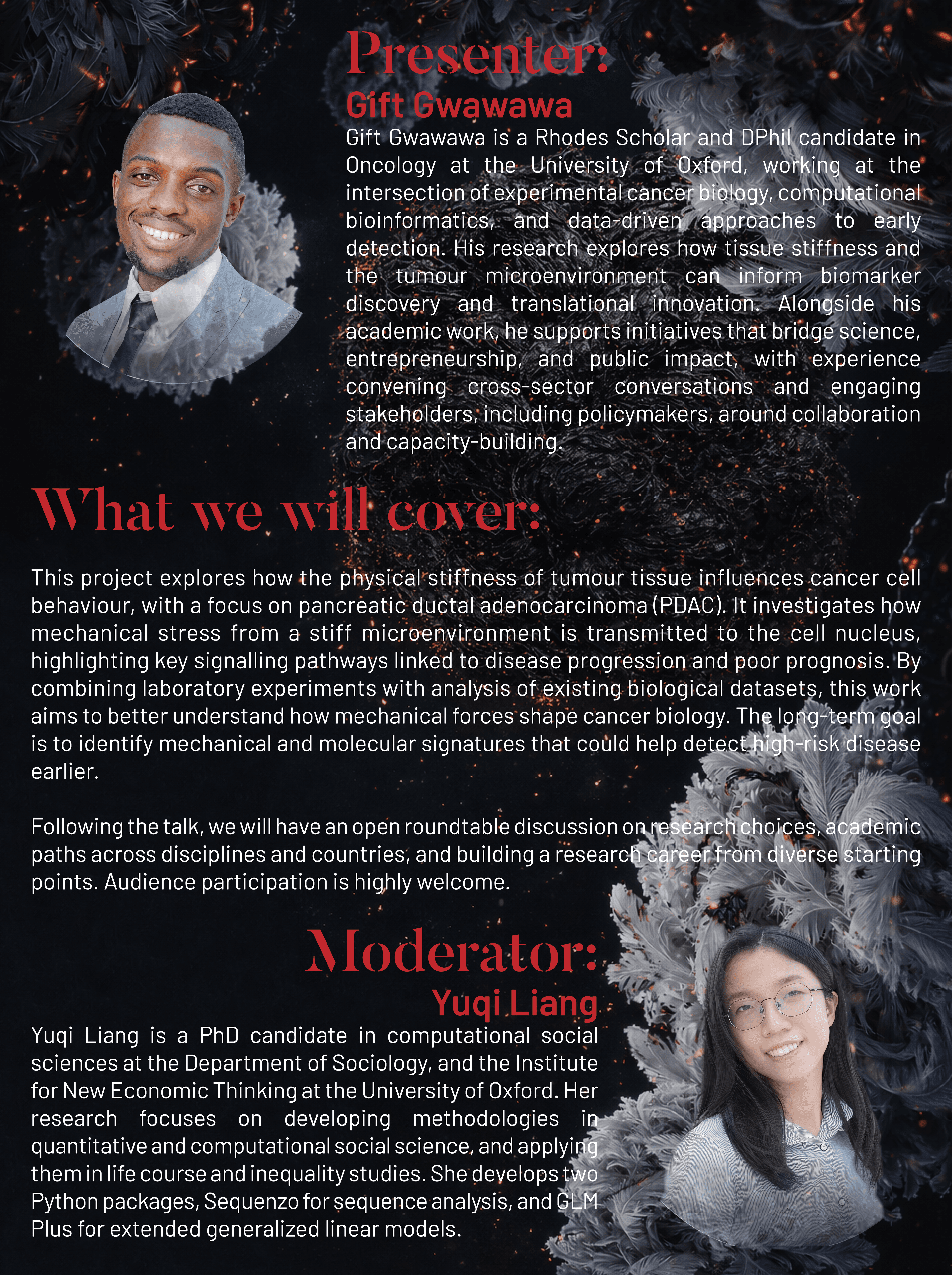
Presenter: Gift Gwawawa
Rhodes Scholar and DPhil Candidate in Oncology, University of Oxford
Gift Gwawawa is a Rhodes Scholar and DPhil candidate in Oncology at the University of Oxford, working at the intersection of experimental cancer biology, computational bioinformatics, and data-driven approaches to early detection. His research explores how tissue stiffness and the tumour microenvironment can inform biomarker discovery and translational innovation. Alongside his academic work, he supports initiatives that bridge science, entrepreneurship, and public impact, with experience convening cross-sector conversations and engaging stakeholders, including policymakers, around collaboration and capacity-building.
Moderator: Yuqi Liang
PhD Candidate, Department of Sociology and Institute for New Economic Thinking, University of Oxford
Yuqi's research focuses on developing methodologies in quantitative and computational social science, and applying them in life course and inequality studies. She develops two Python packages: Sequenzo for sequence analysis, and GLM Plus for extended generalized linear models.
What We Will Cover
This project explores how the physical stiffness of tumour tissue influences cancer cell behaviour, with a focus on pancreatic ductal adenocarcinoma (PDAC). It investigates how mechanical stress from a stiff microenvironment is transmitted to the cell nucleus, highlighting key signalling pathways linked to disease progression and poor prognosis. By combining laboratory experiments with analysis of existing biological datasets, this work aims to better understand how mechanical forces shape cancer biology. The long-term goal is to identify mechanical and molecular signatures that could help detect high-risk disease earlier.
1. A 30-min presentation
Gift presents his research on tumour mechanobiology, walking us through how physical forces in the tumour microenvironment are transmitted to the cell nucleus and what this means for cancer progression and early detection.
2. An 1-hour roundtable discussion between the speaker and the host
Following the talk, we will have an open roundtable discussion on research choices, academic paths across disciplines and countries, and building a research career from diverse starting points. Audience participation is highly welcome.